
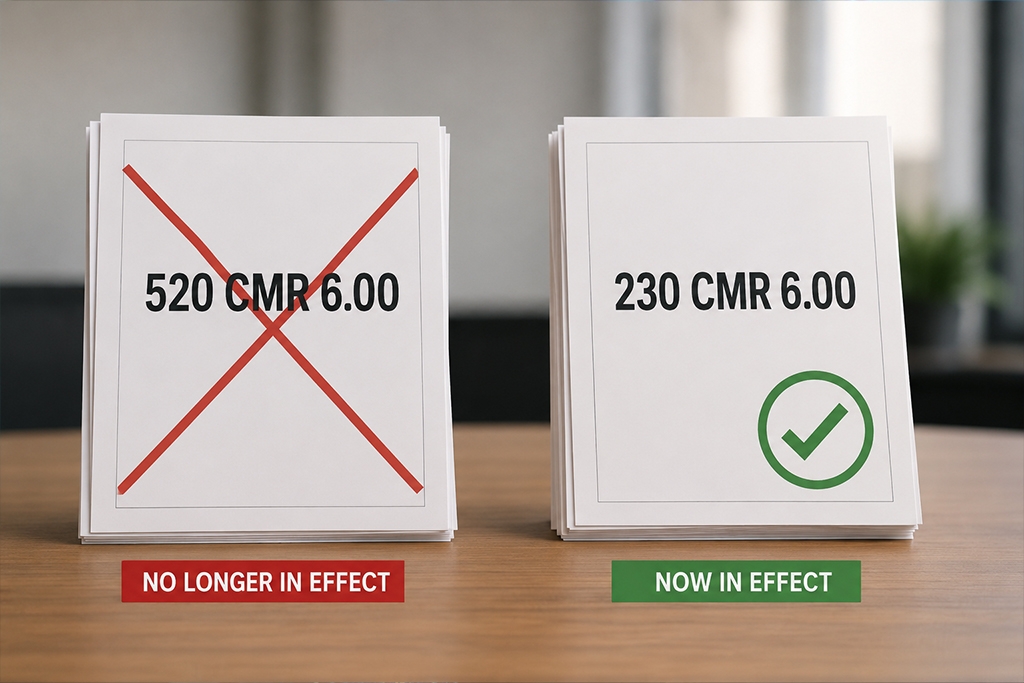
In November 2025, Massachusetts quietly published some hoisting regulation changes that impact equipment operators, employers, apprentices, and more.
Previously, the hoisting regulations in Massachusetts were codified as 520 CMR 6.00. Now, you’ll find them in 230 CMR 6.00.
In this article, we’ll cover the biggest changes that every hoisting operator or employer should be aware of:
Classifications of Massachusetts Hoisting Licenses
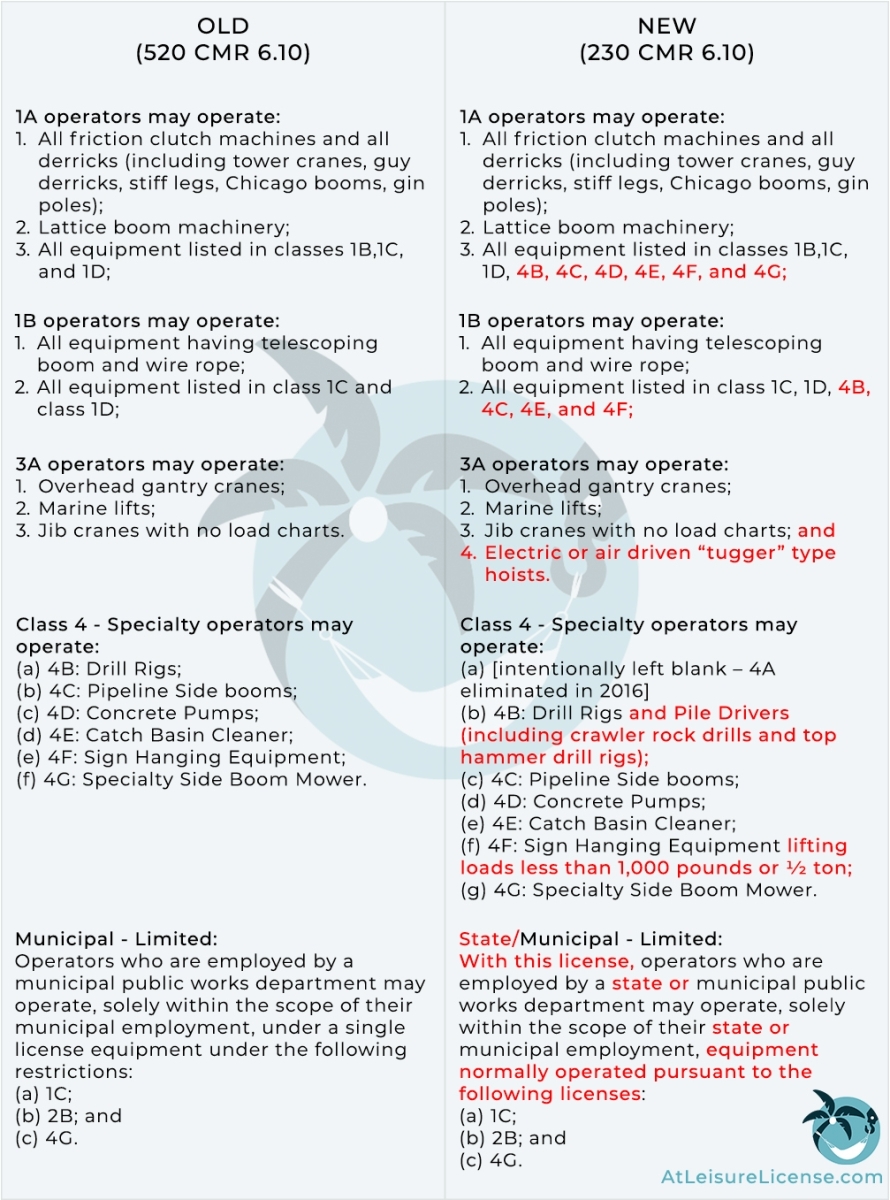
There have been some changes to the classifications of Massachusetts hoisting licenses:
- Individuals who hold a 1A or 1B license may now operate some equipment listed in class 4 (Specialty)
- The code now specifically mentions that 3A operators may operate electric or air driven “tugger” type hoists.
- 4B equipment now includes “pile drivers (including crawler rock drills and top hammer drill rigs)”
- 4F equipment now specifies sign equipment “lifting loads less than 1,000 pounds or ½ ton
- The Municipal - Limited license is now referred to as the “State/Municipal - Limited” license and is extended to state employment in addition to municipal employment.
Please see the image below that illustrates the license classification changes:
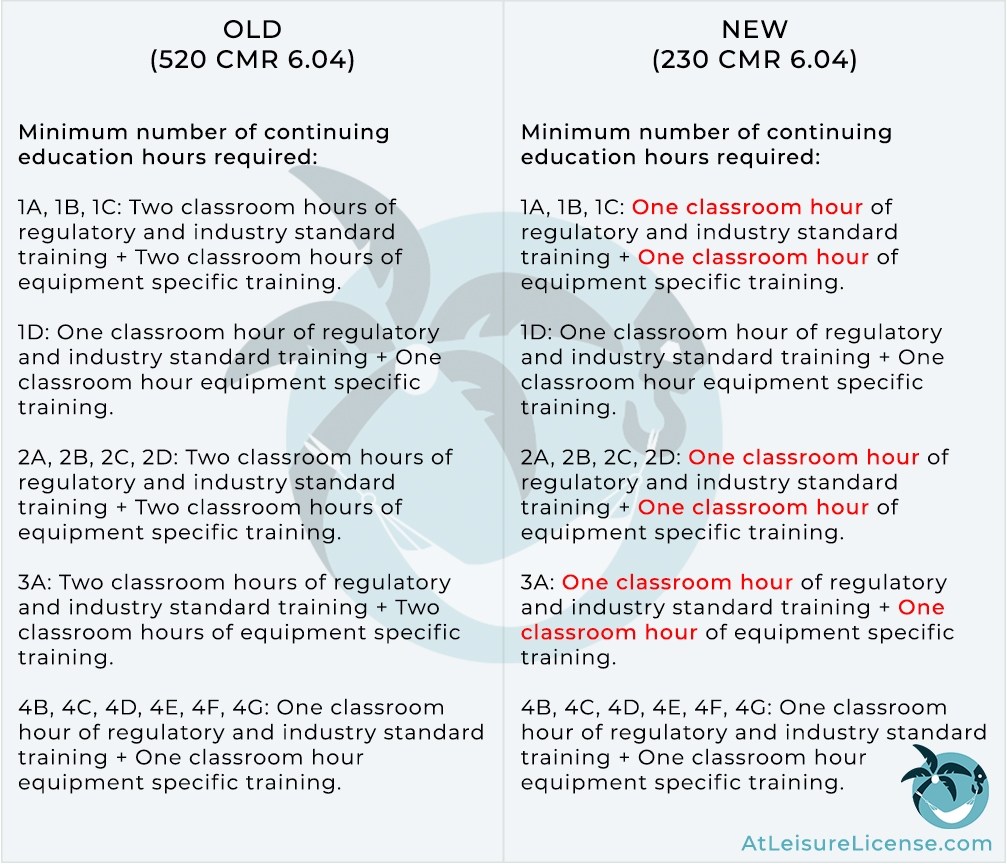
New Mass. Hoisting Con. Ed. Requirements
The minimum number of continuing education hours required for many license grades has been reduced. Previously, some license grades required a minimum of 4 continuing ed. hours while others required at least 2 hours. With the code changes, now ALL license grades require a minimum of just 2 continuing education hours: one hour of regulatory and one hour of equipment specific training.
At Leisure’s redesigned hoisting continuing education experience reflects these relaxed requirements, ensuring you don’t need to spend any more time on your continuing ed. than you have to. The new instructor-led video format makes it easier than ever to complete your continuing ed. and understand the updated regulations.
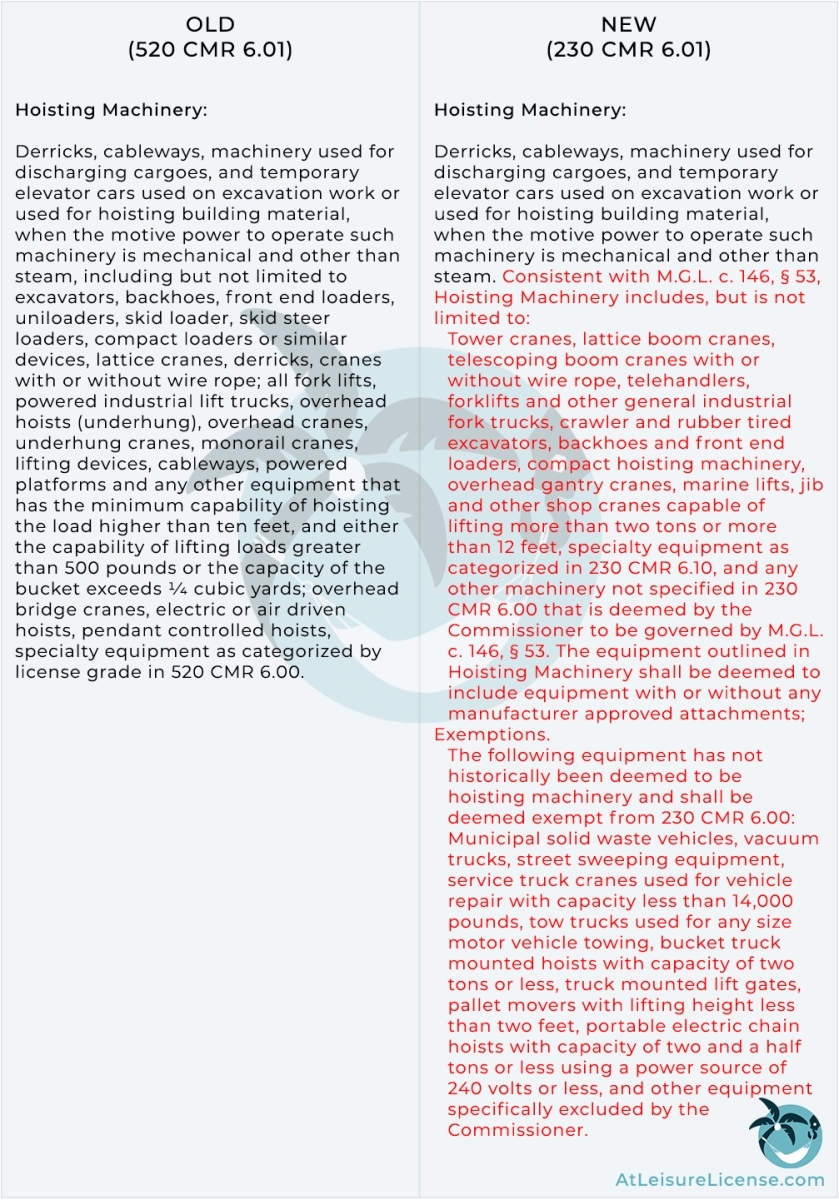
New Definition of Hoisting Machinery in Massachusetts
The definition of “hoisting machinery” in Massachusetts has changed. The new definition explicitly mentions tower cranes, telehandlers, marine lifts, jib and other shop cranes capable of lifting more than two tons or more than 12 feet, and numerous changes to the other equipment inclusions. Additionally, it specifically excludes certain equipment (see "Exemptions" below).
New Massachusetts Hoisting License Exemptions
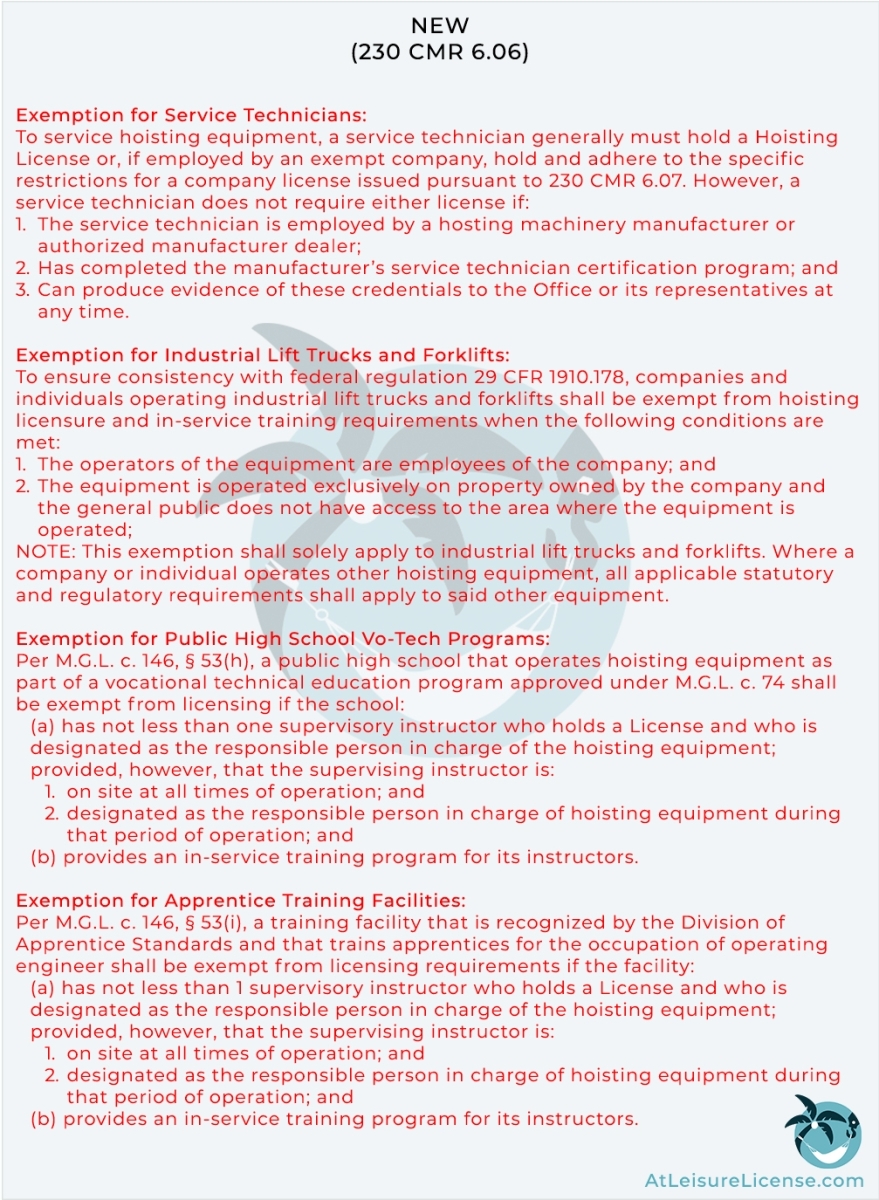
The new code changes in 230 CMR 6.00 brought several new exemptions to Mass. hoisting license requirements. These are scenarios where an individual who operates hoisting equipment may not be required to obtain a full hoisting license (but, in some scenarios, may be required to have an in-service license):
- Service technicians who are employed by a hoisting machinery manufacturer or an authorized manufacturer dealer no longer need to hold a hoisting license (or in-service license) if they have completed the manufacturer’s service technician certification program
- Operators of industrial lift trucks and forklifts may be exempt from MA hoisting license requirements if they meet the conditions listed below
- Public high school vo-tech programs that operate hoisting equipment are exempt from licensing requirements if they meet certain requirements and have an in-service training program
- An approved apprentice training program may be exempt from licensing requirements if they meet certain requirements and have an in-service training program
Changes to Temporary Permits / Short-Term Rental Permits
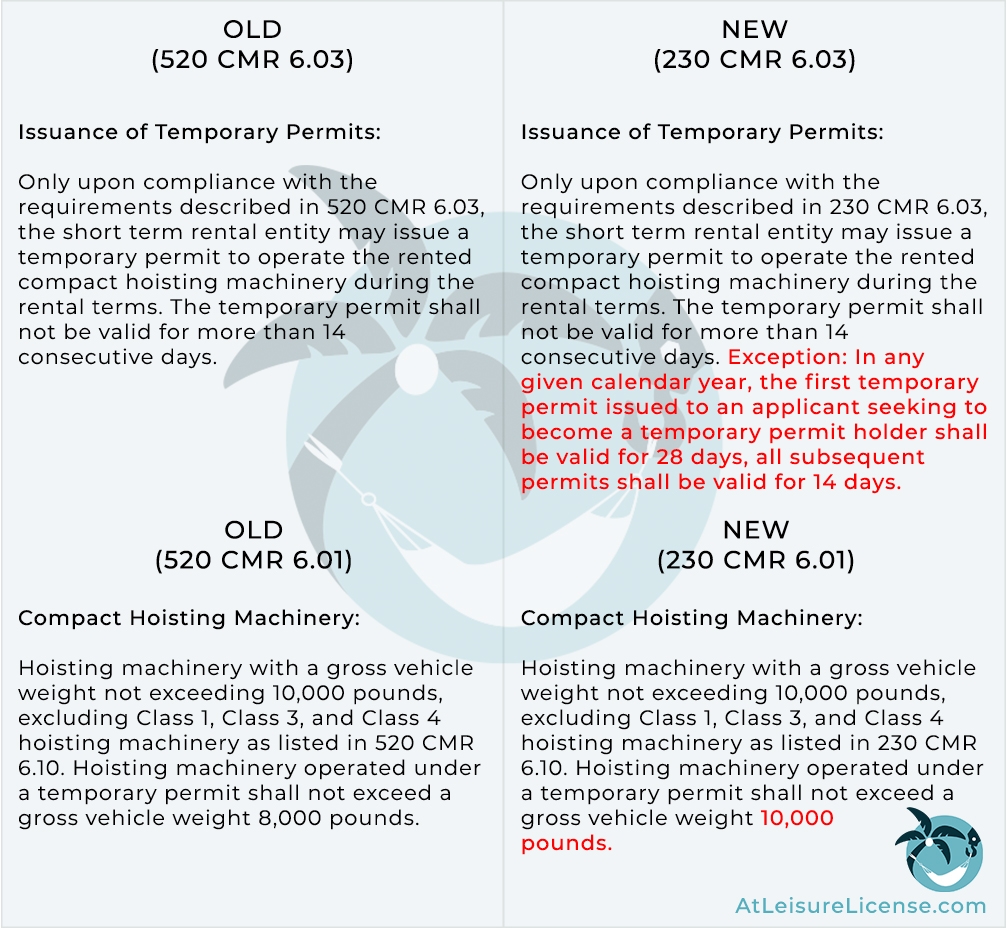
There were two main changes to temporary permits issued by short-term rental entities and the equipment they cover:
- In any given calendar year, the first temporary permit issued to an applicant is valid for 28 days, and all subsequent permits are valid for 14 days (previously, all temporary permits were valid for 14 days)
- The definition of compact hoisting machinery has changed, increasing the gross vehicle weight for machinery operated under a temporary permit from 8k to 10k
Lastly, the regulations no longer list “a photograph of the temporary permit holder” as a requirement for the temporary permit.
Other Definition Changes
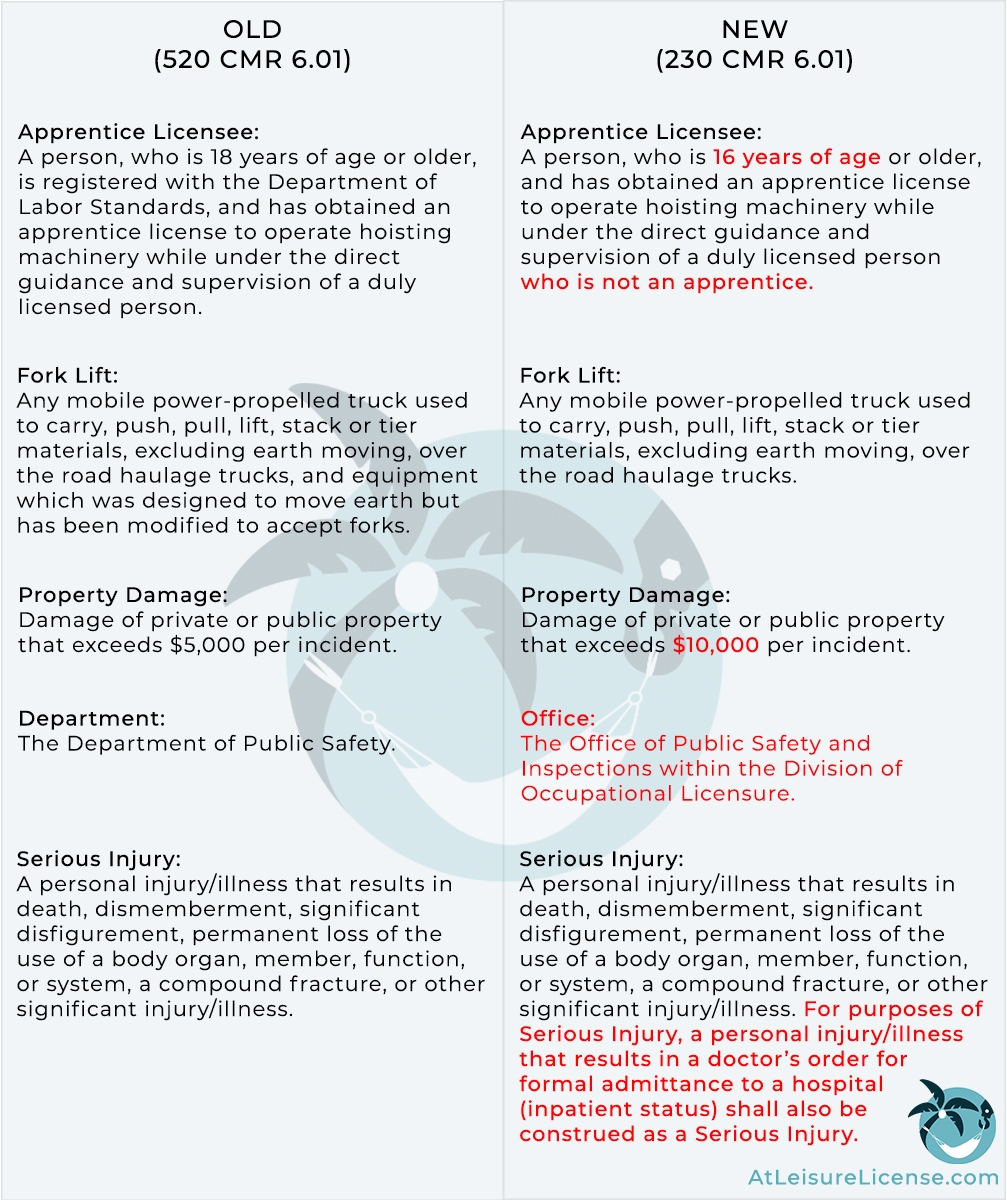
Other significant definition changes that we haven’t already covered are listed below:
Types of Identification Accepted
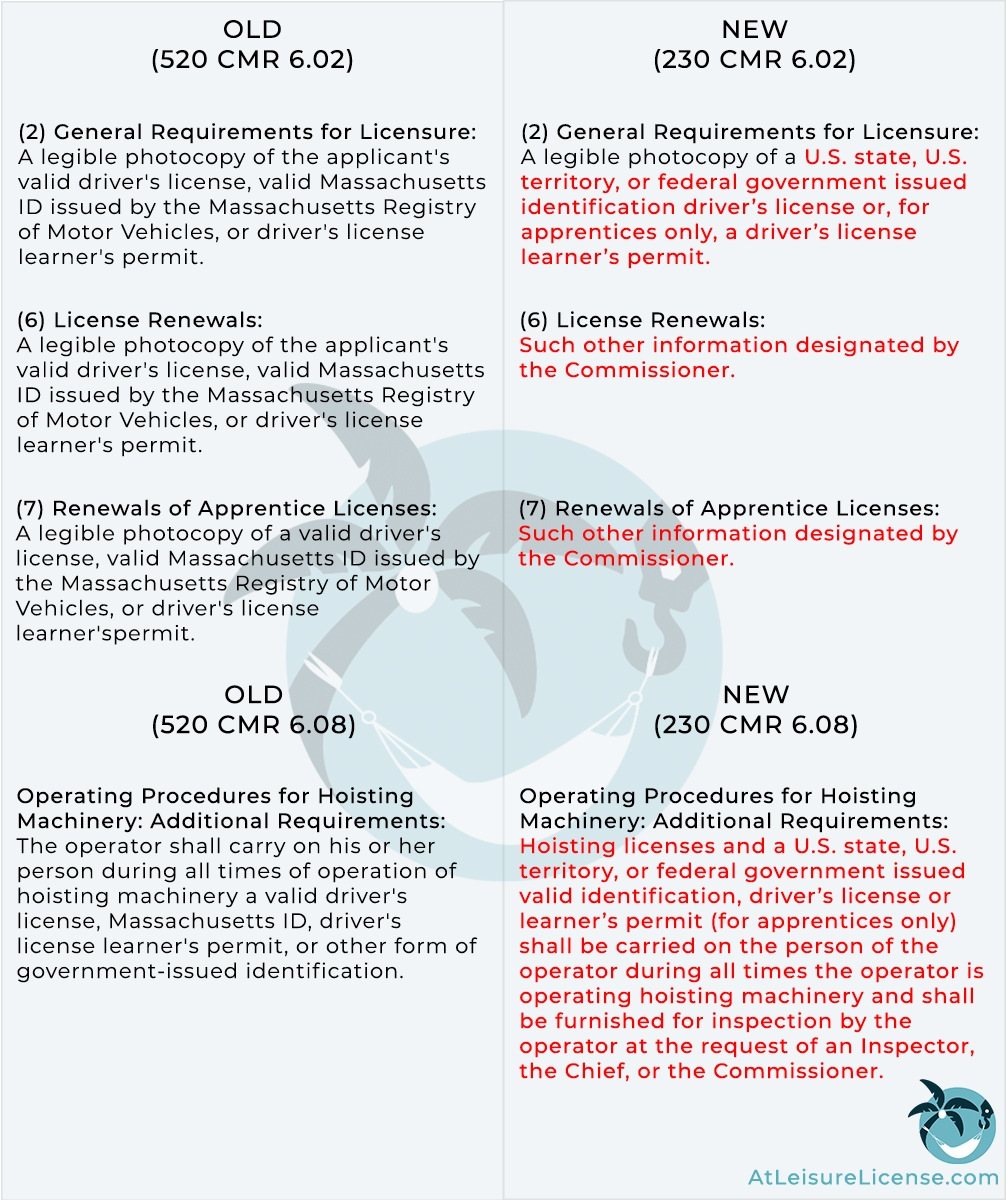
The language surrounding what types of identification is accepted for hoisting licensure has been updated to say “a U.S. state, U.S. territory, or federal government issued identification driver’s license or, for apprentices only, a driver’s license learner’s permit.” This same language is also used to describe what types of identification are acceptable that a hoisting operator must carry on their person at all times while operating machinery.
Additionally, identification photocopies are no longer listed as a requirement for renewals.
Incomplete MA Hoisting Applications, Denials of Licensure, and Hearing Rights
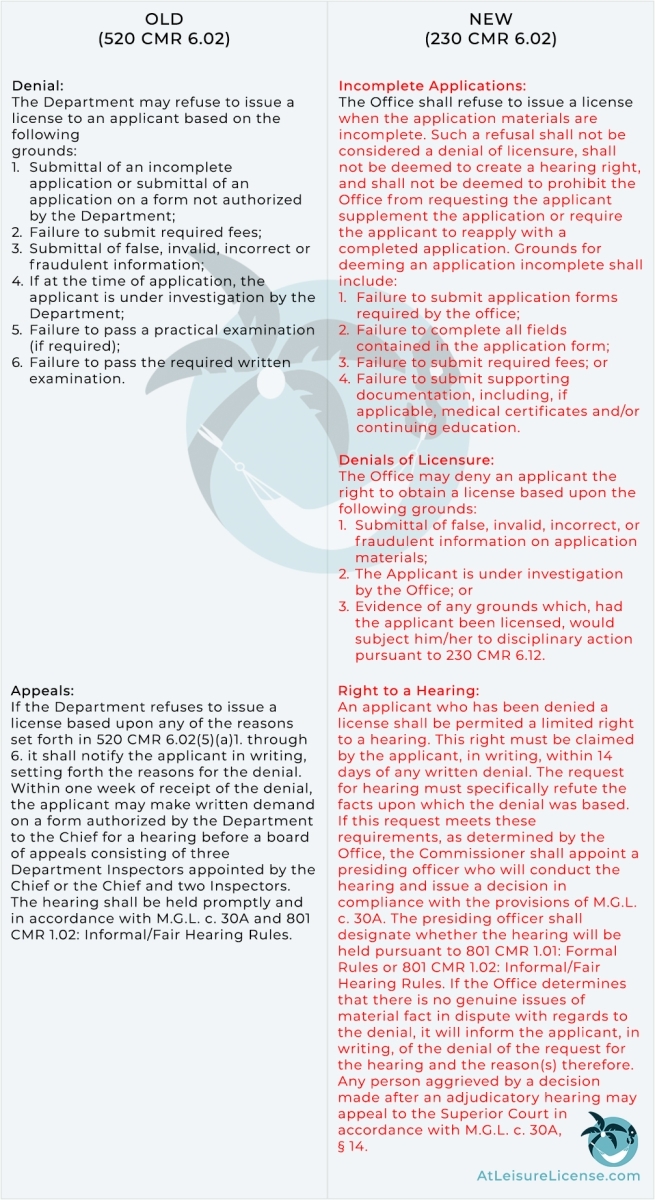
There have been significant changes to the language surrounding hoisting application denials and the related hearing rights. First off, they’ve created two separate categories of reasons why the Office of Public Safety and Inspections (OPSI) may refuse to issue a hoisting license to an applicant:
- Incomplete Applications: These are scenarios where the application is considered incomplete, such as the applicant failing to complete the entire application or submit the required fees. The new code explicitly states that these types of refusals are NOT considered denials of licensure and do NOT create a hearing right. [230 CMR 6.02(4)(a)]
- Denials of Licensure: These are scenarios where the OPSI actually denies the applicant the right to obtain a license. Examples include submitting fraudulent information on the application or the applicant being under investigation. [230 CMR 6.02(4)(b)]
An applicant who has been denied a license (under the second category above) has a “limited” right to a hearing, which must be claimed by the applicant in writing within 14 days of receiving the written denial (this has been increased from one week).
Disclosure of Conviction
The new regulations require that a hoisting licensee informs the Office of Public Safety and Inspections (OPSI) of any conviction made against them, (regardless of whether it is a felony or misdemeanor).
Additionally, the licensee must report any discipline issued against an occupational license imposed by a licensing board of another jurisdiction.
This disclosure must be submitted to the OPSI within 15 days of the finding or conviction.
The exact code language follows below [520 CMR 6.11(5)]:
Each licensee shall disclose to the Office any conviction (regardless of whether it is a felony or misdemeanor) made against them, as well as discipline issued against an occupational license imposed by a licensing board of another jurisdiction (or equivalent authority). Said disclosure must occur within 15 days of the finding or conviction.
Disciplinary Action and Appeals
Section 6.12 was previously titled “Suspension, Revocation, and Appeals of Licensing, Certification, and Temporary Permitting,” and is now titled “Disciplinary Action and Appeals.”
The way it is written now, the list of actions in 6.12 can result in “disciplinary action” (how it was written in the previous list in 520 CMR was that the license could be “revoked or suspended”).
The list of actions that can get you in trouble has lengthened, from 11 to 17 bullet points:
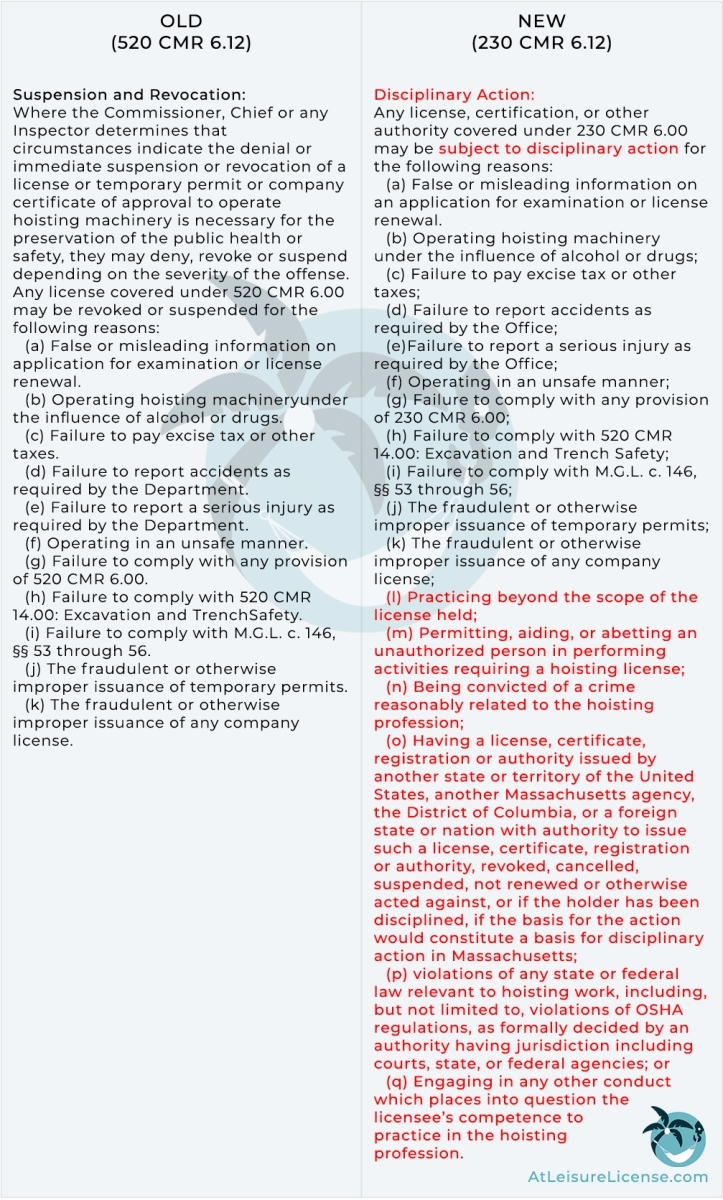
230 CMR 6.12 states that the disciplinary action for these offenses can include (but is not limited to) the following:
- License suspension or revocation
- Decline to renew license
- Probationary conditions placed on license
- Retention or future consideration of reinstatement of the license
- Reprimand or censure a holder
- Penalties or fines
- Additional education and training requirements for the licensee
- Requirements that the licensee practice under appropriate supervision for a period of time as a condition of retention or future consideration of reinstatement of the license
- Requirements that the licensee participate in an alcohol or drug rehabilitation program as a condition of retention or future consideration of reinstatement of the license
In the event that a license is immediately suspended, a hearing must be held within 10 days. Failure of the licensee to attend this hearing shall be deemed grounds to revoke the license.
There is a lot of new information in 230 CMR 6.12, and we recommend that you read it in its entirety.
Other MA Hoisting License Regulation Changes
Some other code changes that may impact you are:
- Applications for licensure may now require an email address unless the applicant certifies that they do not have one [230 CMR 6.02(2)(b)1.]
- The Commissioner may, in their discretion, waive the hoisting examination requirement if the applicant possesses a nationally recognized certification that is, in the opinion of the Commissioner, substantially equivalent to, or greater than, the requirements in Massachusetts. [230 CMR 6.02(3)(c)]
- Applicants for an apprentice license are exempt from any examination requirements [230 CMR 6.02(3)(d)]
- The code no longer requires that a hoisting license be carried on the person of the operator while operating hoisting machinery [was 520 CMR 6.02(4)]
- 230 CMR 6.02(6) License Renewals now states “A renewal may be denied for any reason which would have justified the denial or discipline of a license, subject, if applicable, to any hearings required by law.”
- The new code states that hoisting machinery must be operated in compliance with 230 CMR 6.08 and OSHA Standard 29 CFR 1910 and Standard 29 CFR 1926. In the event there is a conflict between 230 CMR 6.08 and those OSHA standards, “the provisions which establish the higher standard for the promotion and protection of safety and welfare shall prevail.” [230 CMR 6.08]
- New language in Operating Procedures for Hoisting Machinery now states in #8: “Operators shall ensure all safety equipment, including seat belts and other manufacturer installed devices, are in proper working order before utilizing hoisting equipment. All such safety equipment must be utilized when operating hoisting equipment.” [230 CMR 6.08(2)(c)]
- Language in 230 CMR 6.09 (5)(c) (Special Requirements for Excavating Machines, Including Backhoes and Front end Loaders) has changed, and now specifies that the supervisor of an operating apprentice may not be an apprentice: “No person except the operating crew or apprentice licensee operating under the direct supervision of a duly licensed operator who is not an apprentice shall be permitted on an excavating machine while it is in operation.”
- The Accident Reporting section in the new regulations has been shortened, and there have been changes to the Investigation section [230 CMR 6.11(4)]
- The Variance Procedure section (6.13) has been shortened (520 CMR 6.13(3) was removed).